
Regard
Curated by Rachel Hakimian Emenaker
Yasmine Nasser Diaz, Lauren Elder, Muriel Ahmarani Jaouich, Samar Al Summary, Haniko Zahra, and Aneesa Shami Zizzo
November 13 - December 19, 2026
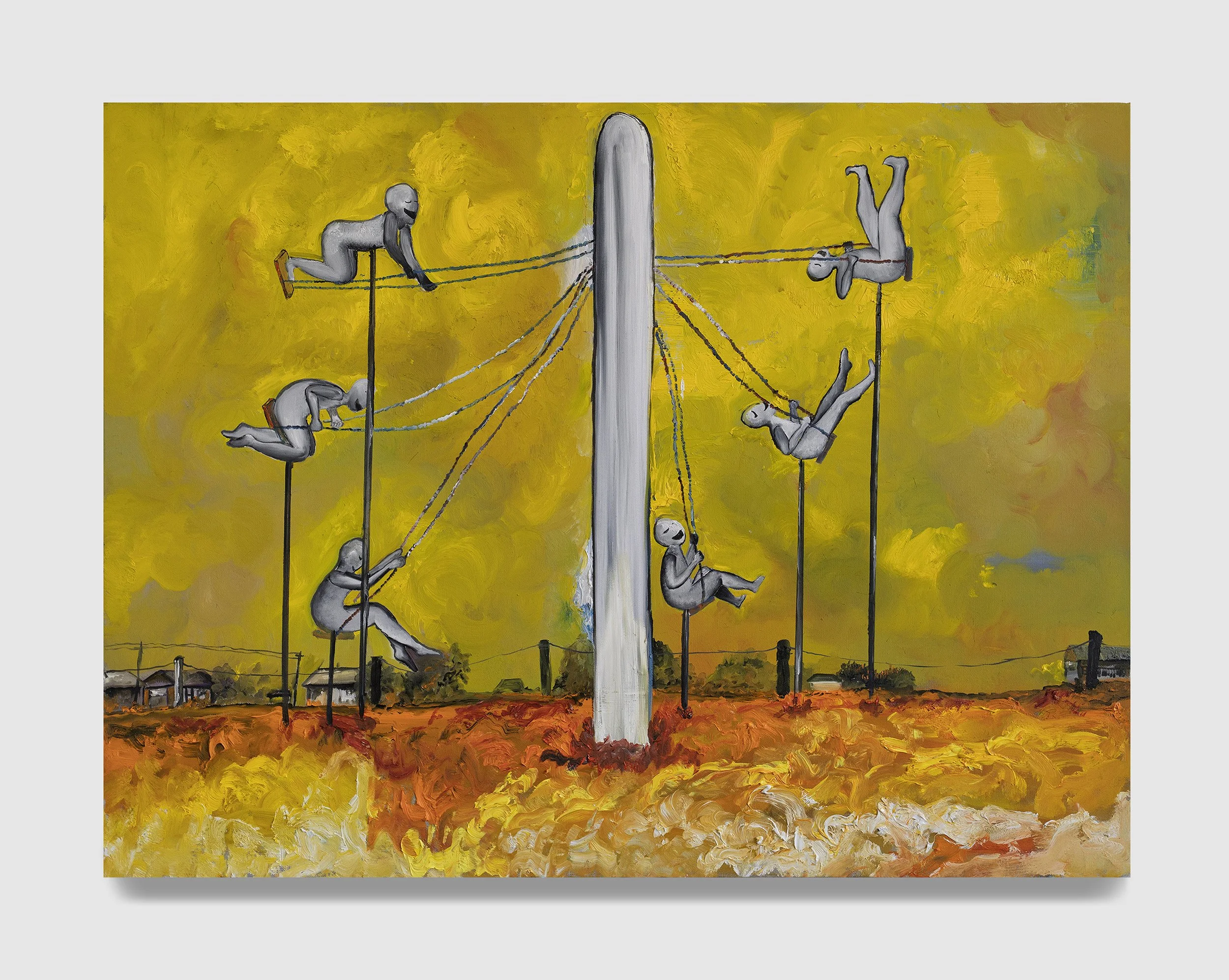
Haniko Zahra, Infinity, 2026, oil on canvas, 30 x 40 in.
Yasmine Nasser Diaz is a visual artist whose work often inhabits domestic spaces to explore cultural identity, feminism, and social critique. Her work has been exhibited at the Getty Center, the Los Angeles County Museum of Art, Station Beirut in Lebanon, and the Poetry Project Space in Berlin. Her mixed media works are part of the permanent collections at LACMA, the Arab American National Museum, The Columbus Museum, and UCLA. Diaz has been awarded the Harpo Visual Artists Grant, the California Community Foundation Visual Artist Fellowship, and the Efroymson Visiting Artist Residency at the University of Michigan in Ann Arbor.
Lauren Elder is a ceramic and mixed-media artist originally from Los Angeles and currently based in Fayetteville, Arkansas. Her work explores the intersections of material, form, and narrative, spanning painting, ceramic sculpture, and bronze casting. Through these mediums, she investigates themes of transformation, memory, and cultural identity. Elder earned her BFA from the School of the Art Institute of Chicago and is currently pursuing her MFA at the University of Arkansas, School of Art. Her work has been exhibited internationally in cities including London, Hong Kong, New York, Chicago, Amsterdam, Toronto, and Los Angeles. She has also shown at notable institutions such as the Museum of Contemporary Art in Chicago and the Utah Museum of Contemporary Art in Salt Lake City. Through a multidisciplinary approach, Elder continues to push the boundaries of ceramics and mixed media, creating works that invite dialogue between tradition and experimentation.
Muriel Ahmarani Jaouich is a Canadian artist of Armenian, Egyptian, and Lebanese descent whose painting practice explores genealogy, intergenerational trauma, and historical violence. Deeply rooted in her family's histories of diaspora, immigration, and genocide, her work draws from oral histories, photographic archives, and inherited objects. She transforms these sources into narratives that weave memory and imagination, resonating with the complexities of ancestral grievance. Her practice is grounded in a continual process of listening, with the belief that attending to ancestral grievance can create pathways toward liberation for present and future generations.
Ahmarani Jaouich lives in Tiohtià:ke / Montreal, Quebec, on the traditional territory of the Kanien'kehá Nation. She is a recipient of the Lilian Vineberg Scholarship, Merit Scholarship, and Tom Hopkins Memorial Award. Her work has been exhibited at the Montreal Museum of Fine Arts, Patel Brown, CLARK Center, articule, Printemps du MAC, and Arsenal New York. Her paintings are held in institutional and corporate collections, including the Doris McCarthy Gallery, Hydro-Québec, RBC, and Scotiabank, as well as in private collections in the United States, Italy, Czechia, Spain, and Canada. Ahmarani Jaouich is represented by Patel Brown.
Samar Al Summary is a Saudi-American artist who has misshapen uneven teeth, so would be perfect period or low-income or foreign casting. Her work records the impact crater that appeared after we tried to go home. She was trained at Ashkal Alwan in Beirut and UCLA. She lives in the ativan sun of Los Feliz. Kidding, she lives to the south of those blessed neighborhoods.
Haniko Zahra is an Iranian artist based in Los Angeles. She received her MFA from the University of California, Los Angeles (UCLA) in 2024. Her practice explores the psychological and emotional dimensions of control, vulnerability, and displacement. Working primarily through figurative painting, she examines the body as a site where social structures, power, and personal experience intersect.
Shaped by her experience of living within patriarchal systems, Zahra’s work considers how external forms of control become internalized, continuing to influence gestures, behaviors, and relationships even after their immediate structures are no longer present. Her paintings often begin with familiar situations, bodies, and interactions that gradually shift into something unsettling or ambiguous. Through subtle distortions, interrupted gestures, and unstable narratives, she creates images in which care and control, intimacy and discomfort coexist.
Her practice is informed by the experience of moving between cultural and political contexts, exploring how displacement transforms one’s relationship to the body, identity, and belonging. Rather than illustrating these experiences directly, Zahra is interested in their lingering psychological effects and the tensions that remain unresolved.
Aneesa Shami Zizzo (b. 1992, Shawnee, KS) is a Los Angeles-based artist exploring shared memory through appliqued tapestries, soft sculpture and paper collage. Zizzo’s work has been exhibited nationally and internationally, including at the Barbican Centre (London, UK), Tribeca Festival (NYC), Craft in America (Los Angeles, CA), Kleefeld Contemporary Art Museum (Long Beach, CA), and the Torrance Art Museum (Torrance, CA), among others. Upcoming exhibitions include a solo presentation at Kleefeld Contemporary Art Museum, and participation in a group exhibition at Craft Contemporary. She holds a Bachelor of Fine Arts in both Fiber and Art History from the Kansas City Art Institute (Kansas City, MO), and is a recipient of the Arab American National Museum residency (Dearborn, MI), the IOS Willie Stoffer Visual Artist Grant (Inglewood, CA), and the Crafting the Future Microgrant (Los Angeles, CA). She is a frequent volunteer at Able ARTS Work in Long Beach, CA, where she collaborates with resident artists on various projects.
Zizzo often reflects on her identity as a second-generation Arab-American, intertwining personal history, world mythologies and the sublime to explore broader narratives of human experience and cultural memory. Through abstraction, she addresses feelings of ruination and the possibility of renewal by using textile industry waste to create soft sculptures, appliqued tapestries and rug weavings. Drawing from a lineage of craftsmen and quiltmakers, Zizzo taps into her subconscious while methodically hand stitching and knotting, considering the process of constructing and reclaiming one’s identity by attending to shared memory. The resulting meditative works reflect the cyclical nature of storytelling tradition, including tales of destruction, recovery, and hope, that comment on the societal systems contributing to waste and neglect, echoing themes of resilience in the face of adversity.
Mek Contemporary is pleased to present Regard, a group exhibition curated by Rachel Hakimian Emenaker, bringing together six artists working across painting, textiles, sculpture, and archival imagery. On view from November 13 through December 19, 2026, the exhibition explores the relationship between visibility and recognition, examining how images shape our understanding of bodies, identities, and histories.
An image can preserve a history while distorting it, revealing something about its subject while exposing the expectations of the viewer. The artists in Regard approach this tension from distinct positions, exploring how bodies, identities, and histories are represented and what remains beyond the frame. Their works move between personal experience and political histories, inherited narratives and imagined worlds.
For women whose bodies and cultures have long been subjected to Orientalist fantasies and the patriarchal gaze, visibility can bring both possibility and constraint. The expectation to challenge these representations can impose further demands: to speak for a culture, explain an experience, or transform suffering into a legible narrative. The artists complicate these expectations, making space for pleasure, anger, humor, tenderness, and the contradictions of everyday life to coexist.
In Haniko Zahra’s paintings, figures can be furious, vulnerable, joyful, or at ease, sometimes all at once. Yasmine Nasser Diaz examines intimacy, joy, and cultural expectation through the boundaries between private experience and public perception. Lauren Elder draws on mythology, Persian miniature painting, and ornament to reimagine inherited stories and challenge familiar narratives.
Muriel Ahmarani Jaouich’s paintings draw on her Armenian, Egyptian, and Canadian identities, bringing together different cultural worlds without reconciling them into a single narrative of belonging. Samar Al Summary works with archival photographs from military camps to question the authority of the documentary image and the histories left outside its frame. Aneesa Shami Zizzo cuts and reconstructs imagery from National Geographic alongside reclaimed textile waste, reconsidering how inherited narratives are assembled and what might emerge from their fragments.
Although these artists share concerns with representation, memory, and identity, their works resist a single perspective. Moving between political histories and personal experience, inherited traditions and imagined worlds, they challenge the idea that a person or a culture can be fully understood through the images made of them.
To regard is to look, but also to consider, value, and hold in esteem. Regard invites close attention without assuming that looking grants complete understanding, acknowledging both what an image reveals and what remains beyond its frame.
Rsvp at info@mekcontemporary.com.
INSTALLATION VIEWS